Placement & training teams: 2026–27 campus calendars are being locked now. Request a proposal →

Credit-integrated programme design

Curriculum development
that earns real credits.

We write industry content into your degree as credit-bearing courses - 56 credits over 880 contact hours - and hand over the course outlines, session plans, lab manuals, assessment blueprint and question banks your academic office has to file. Your faculty co-teach from semester one.

The credentials a placement committee checks first.

Approved by the bodies that govern skilling in India - and chosen by 120+ institutions to own their placement number.

CIIIndustry partner - academic credits
NCVETApproved awarding body
NSDCApproved skilling partner
NASSCOMApproved industry partner
ILOLabour initiatives partner
CourseraGlobal instructor partner
Trusted by

Institutions that already run Board Infinity programmes

Among 120+ institution clients, including 15 IIMs and IITs, 45 of the top-100 NIRF institutions and QS top-200 partners - who between them put 40,000 students through Board Infinity training last year.

IIM CalcuttaIIM Calcutta
IIM TiruchirappalliIIM Tiruchirappalli
IIM VisakhapatnamIIM Visakhapatnam
SPJIMRSPJIMR
XLRI JamshedpurXLRI Jamshedpur
32.5%delivered by Board Infinity
500+self-paced hours
35discipline specialisations
6capstone projects
3internships built in
Why bolt-on training stalls

Three reasons industry content never reaches the syllabus

Training that sits outside the degree gets treated like it

A Saturday programme with no credit attached competes with everything else in a student's week, and loses. Attendance decays from November and the placement season arrives with a half-trained batch.

The syllabus is three hiring cycles behind

Revising a course structure takes a board of studies, an academic council and a year. Recruiters change their test pattern every season. The gap is structural, not a matter of effort.

An external vendor inside a credit course is an audit risk

The moment industry content carries credits, someone has to answer for who taught it, how it was assessed, and whether the marks can be defended. Most training vendors have no answer.

What we build

Eight deliverables, and your faculty owns all of them.

A curriculum engagement produces documents your academic office can file, not a proposal deck. Everything below is handed over.

Credit and hour mapping

Every course mapped to a credit weight and a contact-hour count that fits the structure you already have approved, so nothing goes back to the board of studies twice.

Semester-wise course outlines

Module list, topic breakdown and the prerequisite chain, written the way your course file expects it rather than as a training brochure.

Session plans and lab manuals

Session by session, with the hands-on assignment attached to each one and a lab manual your faculty can run without us in the room.

Assessment blueprint

What is graded, by which instrument, at which point in the semester: programming assignments, timed challenges, weekly quizzes, end-of-semester practicals, viva.

Tagged question banks

Topic- and difficulty-tagged, randomised per student, and loaded straight into Infy Assess so the same bank drives practice and the graded paper.

Project and capstone briefs

Six capstones and two hackathons across the programme, each with a brief, a milestone plan and the rubric the viva is marked against.

Faculty enablement

Your faculty co-teach from day one. They get the deck, the lab, the marking scheme and a walkthrough before each module opens, so the programme survives us leaving.

Accreditation-ready documentation

Course files, attainment records, assessment evidence and the integrity protocol, packaged so an NBA or NAAC visit does not become a scramble.

The model

Eight semesters, written as courses

This is the credit-integrated B.Tech model in full - the same table we would put in front of your board of studies. Three courses and one lab a semester, seven credits, 110 contact hours, with aptitude and soft skills running alongside.

Semester 1 · Programming foundation

Communication and aptitude are taught as credit courses from the first semester, not bolted on in the final year.

7credits

Courses this semester, with credits and contact hours

  • 30hProgramming in CCore · 2 credits
  • 30hLogical & Quantitative AptitudeCore · 2 credits
  • 30hCommunication & Soft SkillsCore · 2 credits
  • 20hProgramming Lab (C Language)Lab · 1 credit

Plus 30 hours of aptitude and soft skills training alongside

Semester 2 · Object-oriented programming

The semester that decides whether a student can hold a technical interview three years later.

7credits

Courses this semester, with credits and contact hours

  • 30hObject-Oriented Programming (Java/C++)Core · 2 credits
  • 30hComputer Organisation & Operating SystemsCore · 2 credits
  • 30hWeb Fundamentals (HTML, CSS, JS)Core · 2 credits
  • 20hObject-Oriented Programming LabLab · 1 credit

Plus 30 hours of aptitude and soft skills training alongside

Semester 3 · Data structures and databases

DSA starts in year two, which is the single change that moves a placement number most.

7credits

Courses this semester, with credits and contact hours

  • 30hData Structures - ICore · 2 credits
  • 30hDatabase Management SystemsCore · 2 credits
  • 30hFront-End Web DevelopmentCore · 2 credits
  • 20hDBMS & Front-End LabLab · 1 credit

Plus 30 hours of aptitude and soft skills training alongside

Semester 4 · Algorithms and back-end

Full-stack capability closes here, so the student can carry a project into an interview.

7credits

Courses this semester, with credits and contact hours

  • 30hDesign & Analysis of AlgorithmsCore · 2 credits
  • 30hBack-End Development (NodeJS + MongoDB)Core · 2 credits
  • 30hData Structures - IICore · 2 credits
  • 20hBack-End Development LabLab · 1 credit

Plus 30 hours of aptitude and soft skills training alongside

Semester 5 · Software engineering and advanced DSA

Placement aptitude becomes a credit course, a full year before the drive opens.

7credits

Courses this semester, with credits and contact hours

  • 30hAdvanced DSA - ICore · 2 credits
  • 30hSoftware EngineeringCore · 2 credits
  • 30hAptitude for PlacementsCore · 2 credits
  • 20hDSA LabLab · 1 credit

Plus 30 hours of aptitude and soft skills training alongside

Semester 6 · Applied technology

The one elective slot, so a cohort can split towards data or towards cloud without a syllabus change.

7credits

Courses this semester, with credits and contact hours

  • 30hAdvanced DSA - IICore · 2 credits
  • 30hData Science or Cloud ComputingElective · 2 credits
  • 30hCommunication for PlacementsCore · 2 credits
  • 20hProject / Internship LabLab · 1 credit

Plus 30 hours of aptitude and soft skills training alongside

Semester 7 · Competitive coding and career readiness

Company-specific problem solving is timetabled as a course, with a mock interview lab carrying the credit.

7credits

Courses this semester, with credits and contact hours

  • 30hCompetitive ProgrammingCore · 2 credits
  • 30hCompany-Specific Problem SolvingCore · 2 credits
  • 30hSoft Skills & HR TrainingCore · 2 credits
  • 20hMock Interview LabLab · 1 credit

Plus 30 hours of aptitude training alongside

Semester 8 · Capstone and internship

The final year is assessed on work a recruiter can actually look at: a capstone, an industry report and a portfolio viva.

7credits

Courses this semester, with credits and contact hours

  • 30hCapstone ProjectCore · 2 credits
  • 30hInternship & Industry ReportCore · 2 credits
  • 30hProfessional Readiness & Business CommunicationCore · 2 credits
  • 20hViva / Portfolio LabLab · 1 credit

Plus company-specific training alongside

Beyond computer science

Your other seven departments need this more.

Computer science already has an industry-facing syllabus. Mechanical, civil, chemical and the rest are where a degree and a job description have drifted furthest apart. Thirty-five specialisations are written and ready to be mapped into a course structure.

Mechanical Engineering

5 specialisations written
Smart Manufacturing & Industry 4.0CAD, CAE & Product DesignEV Systems & Automotive TechnologyRobotics & Industrial AutomationSupply Chain & Operations Excellence

Graduates into Graduate Engineer Trainee, Production Engineer, Design Engineer, CAD Engineer, EV Engineer, Automation Engineer

Civil Engineering

5 specialisations written
Smart Infrastructure & Construction TechQuantity Surveying & EstimationPrimavera & Project ManagementSustainable Construction & Green BuildingsGIS & Surveying Technology

Graduates into Site Engineer, Planning Engineer, Quantity Surveyor, Billing Engineer, GIS Analyst, Project Coordinator

Chemical Engineering

5 specialisations written
Process Plant OperationsIndustrial Safety & HSEOil, Gas & Refinery OperationsPharma Manufacturing & QualityData Analytics for Process Industries

Graduates into Process Engineer, Plant Operations Engineer, HSE Officer, QA/QC Associate, Process Data Analyst

Petroleum Engineering

5 specialisations written
Upstream Oil & Gas OperationsEnergy Transition & Renewable FuelsOilfield Safety & HSEPetroleum Data AnalyticsRefinery & Petrochemical Operations

Graduates into Drilling Engineer, Reservoir Operations Associate, Energy Analyst, HSE Engineer, Refinery Operations Engineer

Renewable Energy Engineering

5 specialisations written
Solar PV Design & InstallationWind Energy SystemsEnergy Auditing & SustainabilityBattery Storage & EV InfrastructureSmart Grid & Energy Management

Graduates into Solar Design Engineer, Wind Operations Associate, Energy Auditor, Sustainability Analyst, Smart Grid Engineer

Materials & Advanced Manufacturing

5 specialisations written
Advanced Materials & CompositesAdditive Manufacturing & 3D PrintingQuality Engineering & Six SigmaSemiconductor Materials & FabricationIndustrial Metallurgy & Failure Analysis

Graduates into Materials Engineer, Additive Manufacturing Engineer, Quality Engineer, Semiconductor Process Associate

Bioengineering

5 specialisations written
Medical Devices & Healthcare TechnologyBioinformatics & Data AnalyticsPharma & Biotech Industry ReadinessAI in HealthcareClinical Research & Regulatory Affairs

Graduates into Biomedical Engineer, Bioinformatics Analyst, Biotech Associate, Clinical Research Associate

Who writes it

A syllabus is only as good as who signed it.

Every course is co-authored by an academic who has taught the subject and a practitioner who has done the job. Neither writes alone.

Academic authorship

Visiting professors, associate professors and programme heads from institutions your own faculty will recognise:

SPJIMRIIT DelhiO.P. Jindal Global UniversityXIM UniversityIILM UniversityMasters’ UnionBITSOM

They own the academic rigour: learning outcomes, prerequisite chains, credit weighting and whether an assessment actually measures what the course claims to teach.

Industry authorship

Practising senior professionals, drawn from the same pool that teaches the offline sessions:

Vice PresidentsEngineering DirectorsSenior SDEsData Science LeadsAnalytics HeadsProduct ManagersCloud & DevOps Engineers

They own currency: the language a job description actually uses, the tools a team actually runs, and the problems that turn up in a real interview this season rather than three years ago.

And the paperwork is ours to stand behind. Board Infinity is approved by CII as an industry partner for academic credits, is an NCVET-approved awarding body and an approved partner of NSDC and NASSCOM. CII certification can be added to any course in the programme.

The difference

A syllabus is a document.
A course is a system of record.

The moment a course carries credits, somebody has to be able to produce the enrolment list, the attendance, the question paper each student actually sat, the submission history and the marks - years later, to an accreditor. That is a software problem, and it is the reason a curriculum consultancy alone is not enough.

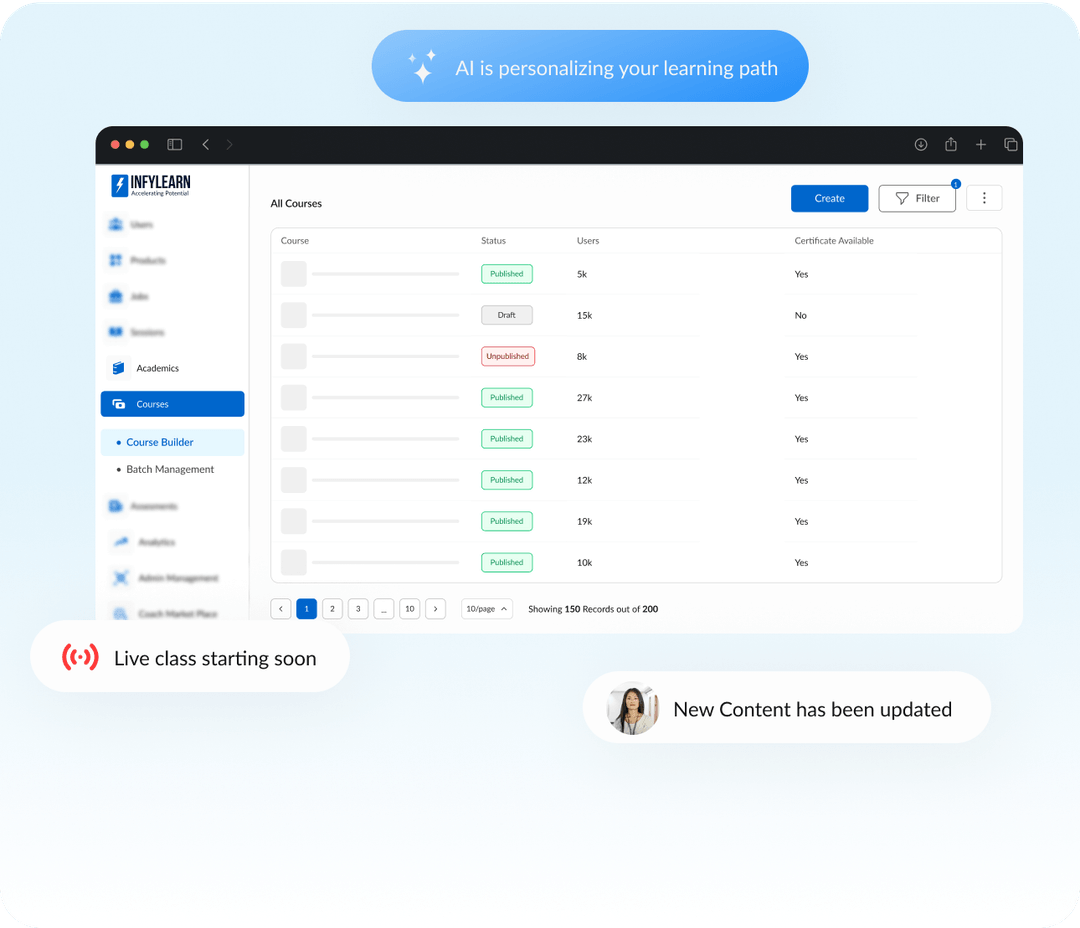
Infy LMS - course management, live product

Infy LMS - course management, live product

Where the course lives

Infy LMS

A credit course needs a system of record: enrolment, attendance, submissions and a certificate at the end.

  • Course builder - every module, session plan, lab sheet and recording published against the semester it belongs to
  • 500+ hours of foundation content - produced in-house, so the self-paced layer is ours to update when a syllabus changes
  • Attendance and progress tracking - per student, per session, per module - the record an audit asks for
  • Certificate generation - issued against completion and graded assessment, white-labelled to your institution
Integrates with your existing ERP or student management system over API, and stays live for twelve months after the last class.
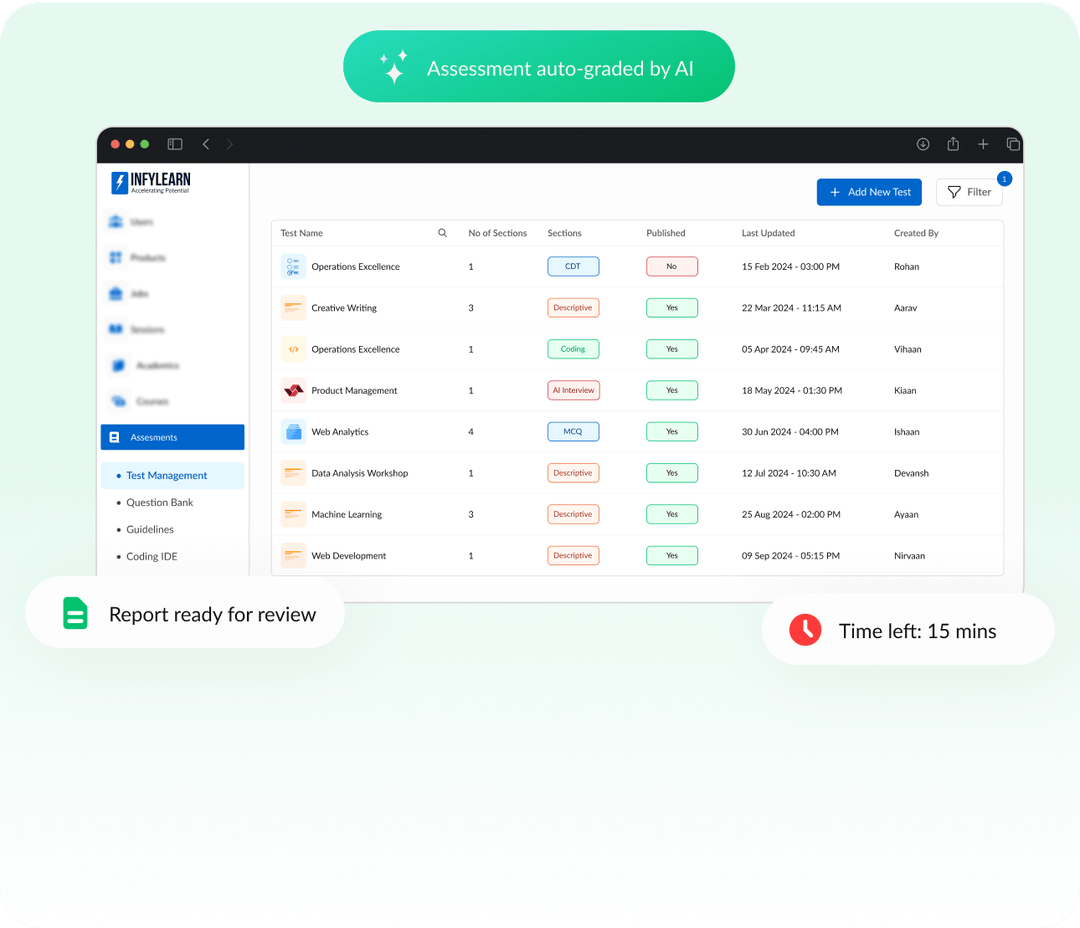
Infy Assess - test management, live product

Infy Assess - test management, live product

Where the marks come from

Infy Assess

The assessment blueprint stops being a document here and becomes the actual paper each student sits.

  • Randomised question banks - topic- and difficulty-tagged, generating a unique paper per student from the same blueprint
  • Real-time coding lab - live editor, multi-language, test-case validation and auto-evaluation for every programming course
  • AI image & video proctoring - flags multiple faces, absence, gaze deviation and tab switches, with violations logged
  • Hybrid grading - auto-marking for code and MCQs, manual marking for projects and vivas, in one gradebook
Also runs project and assignment evaluation and hackathon hosting, which is how the six capstones and two hackathons are marked.
Infy Resume - AI resume builder, live product

Infy Resume - AI resume builder, live product

The career-readiness credit

Infy Resume

Semester 8 carries a Professional Readiness course. This is the tool that course is taught on.

  • AI resume builder - students build against a real job description rather than a template, and iterate on scored feedback
  • Portfolio and project capture - the six capstones and the internship report become artefacts a recruiter can open
  • Progress tracking and leaderboard - the same record that drives the career-readiness marks in the gradebook
  • Built into the credit course - not an optional extra a student may or may not open in final year
Career readiness is a graded module from semester 1 in this model, not a workshop bolted on at the end.

Why it matters when the course carries credits

Marks that cannot be evidenced are marks that cannot be defended.

  • Every paper is reconstructable per student, because it was generated from a tagged bank rather than typed once.
  • Attendance, submissions and marks live in one gradebook, not three spreadsheets and an email thread.
  • The record outlives the engagement and exports to your ERP, so the course file is complete without us.
Included in every engagement

Eight things that are not add-ons

This is the difference between a trainer on a timetable and a programme that moves a batch's numbers. All eight are in the base commercials.

01

Senior faculty, in person

Every class taught on campus by a trainer with 5+ years of teaching experience.

02

Module-wise practice bank

Topic-tagged, so a student weak in Percentages drills Percentages, not a mixed set.

03

E-books & handouts

Produced in-house, so students revise from the same source their trainer taught from.

04

12 months of LMS access

White-labelled to your institution and live for a full year after classes end.

05

Weekly proctored assessments

Under exam conditions on Infy Assess - the reason readiness is a measurement.

06

Monthly challenges & awards

Leaderboards and recognition - the cheapest intervention we know for holding attendance.

07

Remedial classes

Extra sessions for students the data flags as at-risk. Included, not billed separately.

08

Placement-cell reporting

Batch, section and student readiness in one dashboard, plus a termly written report.

Commercials cover offline training, all assessments, learning material and twelve months of platform access. Trainer scheduling assumes a minimum of six hours per trainer per day.

Academic integrity

The question an academic council asks first: can these marks be defended?

A credit-bearing course lives or dies on whether its assessment holds up. Five controls are written into the assessment design before a single session is timetabled.

01

A unique paper for every student

Questions are drawn from a topic- and difficulty-tagged bank, so no two students sit the same paper and a leaked question set is worth nothing. Practical assignments go further: problem variations are assigned by student ID.

Randomised per student
02

Code similarity checks on every submission

Programming submissions run through MOSS-style similarity detection, on a controlled platform that keeps version history - so a submission that appeared fully formed at 2am is visible as exactly that.

MOSS-style detection
03

Offline, invigilated examinations

End-of-semester practicals are taken in person with allocated invigilators and staggered seating. The convenience of an online exam is not worth the mark it produces.

In person, invigilated
04

A viva at every project milestone

Capstones break into milestones with a deliverable and a viva voce at each. A student who cannot explain their own design choices does not carry the marks, whoever wrote the code.

Milestone viva
05

Honour code, surprise checks and peer review

Students sign an academic-honesty agreement, unannounced assessments test authentic learning rather than exam-week cramming, and peer review on group work makes a free rider visible to the people who carried them.

Signed by the student
Reporting

Every institution gets its own readiness report

A live dashboard through the semester and a written report at the end of it - assembled so your academic office can take it into a board of studies or an accreditation visit without rewriting a line.

Board InfinityTerm report · 2026–27
Sample

Academic Attainment Report

B.Tech CSE · Batch of 2029 · Credit-Integrated Curriculum

Students enrolled, semester 3418
Credits attained against 2118.5
Data Structures - I74%
Database Management Systems79%
Lab completion92%
Integrity flags raised and closed7

What's in the report

  • 01Credit attainment - credits earned against credits offered, per student and per course, ready to post to your examination system.
  • 02Course-wise performance - marks by instrument, so a cohort weak on practicals rather than theory is visible while there is still term left.
  • 03Lab and project completion - submissions, milestone vivas and capstone grades against the published rubric.
  • 04At-risk register - every student flagged during the semester, what was done about it, and where they ended up.
  • 05Integrity log - every similarity flag and proctoring violation, the review decision, and who signed it off.
  • 06Course file pack - outlines, session plans, question papers, answer keys and attainment evidence, assembled for accreditation.
Request a sample report
Delivery

Three depths, depending on how much structure you can change.

Not every institution can reopen a course structure. The lighter two models sit inside what you already have approved.

Most impact

4-year credit-integrated

Industry content written into the degree as credit courses from semester one. Board Infinity delivers 32.5% of it; your faculty delivers the rest.

56credits across
880 contact hours
01Semesters 1-2 · FoundationProgramming, aptitude, communication, OOP, systems, web14 cr
02Semesters 3-4 · CoreData structures, DBMS, algorithms, front-end and back-end14 cr
03Semesters 5-6 · AppliedAdvanced DSA, software engineering, one elective, placement aptitude14 cr
04Semesters 7-8 · CareerCompetitive programming, company-specific problem solving, capstone, internship14 cr
05AlongsideAptitude and soft skills, 30 hours a semester through semester 7210 h
06Self-pacedFoundation content, labs, recordings and assignments on the LMS500+ h

Weekend offline delivery by senior industry professionals, 6 capstones, 2 hackathons, 2 virtual internships and a final internship.

3-semester embed

For institutions that can add a skill course but not restructure the degree. Three semesters, taught inside the timetable you already run.

270hours across
three semesters
01Semester AQuantitative aptitude, data interpretation, logical reasoning, verbal90 h
02Semester BRevision, advanced reasoning, technical foundations90 h
03Semester CCompany-specific patterns, mock assessments, interview readiness90 h
04AssessmentAligned to the training curriculum, not set separatelyEvery module
05RevisionTopics from previous semesters are revisited by designEvery semester

Designed against AMCAT and the company patterns your recruiters actually use, with revision of earlier semesters built into each one.

Single 60-hour course

One credit-bearing course, one semester. The usual entry point, and the one that gets a board of studies comfortable with the rest.

60hours across
seven modules
01Introduction to Programming & Problem Solving6 h
02Fundamentals of Object-Oriented Programming6 h
03Basic Data Structures10 h
04Relational Database Concepts6 h
05Entry-Level Coding Problems8 h
06Company Assessments & Problem Solving6 h
07Company-Specific Papers & Interview Simulation18 h

Learn-by-doing throughout: every session is live coding plus immediate practice, with daily homework and company-specific problem sets.

Year by year

Four years, and what each one adds up to.

The same eight semesters, grouped the way a student and a parent actually think about a degree.

Year 1 Semesters 1 and 2
14of 56 credits earned
by the end of this year
220contact hours
6courses
2labs

What is on the transcript

Programming in CLogical & Quantitative AptitudeCommunication & Soft SkillsObject-Oriented Programming (Java/C++)Computer Organisation & Operating SystemsWeb Fundamentals (HTML, CSS, JS)+ 2 labs

Writes and debugs in C and Java, knows how an operating system and a web page work, and carries aptitude and communication on the transcript from the first semester rather than the last.

Year 2 Semesters 3 and 4
28of 56 credits earned
by the end of this year
220contact hours
6courses
2labs

What is on the transcript

Data Structures - IDatabase Management SystemsFront-End Web DevelopmentDesign & Analysis of AlgorithmsBack-End Development (NodeJS + MongoDB)Data Structures - II+ 2 labs

Designs a database, builds a front end and a back end against it, and can reason about the complexity of an algorithm - the full stack, plus the data structures a technical interview opens with.

Year 3 Semesters 5 and 6
42of 56 credits earned
by the end of this year
220contact hours
6courses
2labs

What is on the transcript

Advanced DSA - ISoftware EngineeringAptitude for PlacementsAdvanced DSA - IIData Science or Cloud ComputingCommunication for Placements+ 2 labs

Advanced data structures, software engineering practice and one elective in data science or cloud. Placement aptitude becomes a graded course a full year before the drive opens.

Year 4 Semesters 7 and 8
56of 56 credits earned
by the end of this year
220contact hours
6courses
2labs

What is on the transcript

Competitive ProgrammingCompany-Specific Problem SolvingSoft Skills & HR TrainingCapstone ProjectInternship & Industry ReportProfessional Readiness & Business Communication+ 2 labs

Competitive programming and company-specific problem solving, then a capstone, an industry report and a portfolio viva - a final year assessed on work a recruiter can actually open.

6capstone projects
2hackathons
3internships
500+self-paced hours
210bootcamp hours alongside

Of the 880 contact hours, 720 are taught as theory and 160 in labs, across 56 credits - 48 from courses and 8 from labs. Request a proposal for costing against your batch size, your discipline mix and the delivery share you want to keep in-house.


Questions from academic councils

Frequently asked questions

How is this different from a training vendor?

A training vendor sells you hours beside the degree. This is written into the degree: courses with credit weights, contact hours, session plans, an assessment blueprint and a course file your academic office can defend at an accreditation visit. We also co-deliver rather than take over - Board Infinity teaches 32.5% of the credit-integrated model and your faculty teaches the rest, from the same materials.

Are the assessments proctored, and how?

Yes, on Infy Assess. AI image and video proctoring flags multiple faces in frame, a student leaving the frame, gaze deviation and tab switching, with violations logged for review. End-of-semester practicals are additionally taken offline with allocated invigilators and staggered seating, because for a credit-bearing practical that is the only defensible format.

What tracking does our placement cell actually get?

Credit attainment per student and per course, marks broken down by assessment instrument, lab and capstone completion against the published rubric, an automatic at-risk register, a full integrity log, and a course file pack assembled for accreditation. It is an academic report first and a placement report second, which is the correct order for this service.

What is Board Infinity accredited by?

Accredited and approved by CII as an industry partner for academic credits, an NCVET-approved awarding body, and an approved partner of NSDC and NASSCOM. We are also an ILO partner on labour initiatives and a global Coursera instructor partner alongside organisations like IBM and Google. CII certification can be added to any course in the programme.

Do we have to change our course structure?

Only for the four-year model. The three-semester embed and the single 60-hour course are designed to sit inside a structure you already have approved, which is why most institutions start there. Once one course has run and the attainment data exists, taking the full model to a board of studies is a much shorter conversation.

Who actually teaches it?

Both. Offline sessions in the credit-integrated model are delivered on weekends by senior industry professionals, and your faculty co-teach from the first semester with the deck, the lab sheet, the marking scheme and a walkthrough before each module opens. The handover is the point: the programme has to survive us leaving.

Can this work for departments other than computer science?

That is where it matters most. Thirty-five specialisations are written across mechanical, civil, chemical, petroleum, renewable energy, materials and bioengineering - five per discipline - and each maps into a course structure the same way. Computer science already has an industry-facing syllabus; the other departments usually do not.

How do you stop students gaming the assessments?

Five controls, all designed in before the first session: a randomised paper per student from a tagged bank, MOSS-style code similarity checks on a platform that keeps version history, invigilated offline practicals, a viva at every project milestone, and a signed honour code backed by surprise assessments and peer review on group work.

What happens to the material when the engagement ends?

You keep it. Course outlines, session plans, lab manuals, question banks, project briefs and rubrics are handed over, and the LMS stays live for twelve months after the last class with an API export to your own ERP or student management system.

What does it cost?

It depends on the model, the number of disciplines and how much delivery you keep in-house, which is why there is no price on this page. Tell us your batch size and which of the three models you are considering and you get costing against that. Optional add-ons - Coursera licences, CII certification, one-to-one mentoring, IIT and IIM immersions - are quoted separately so you can take them or leave them.

Next step

Let's put a costed plan against your batch

Tell us your discipline, your batch size and how much of your course structure is open. We come back with a credit and hour map, a semester plan and commercials - usually within three working days.

  • A free curriculum audit of one existing course, mapped against what your recruiters are currently testing.
  • A credit and contact-hour map against your existing structure, so nothing goes back to the board of studies twice.
  • A sample course file - outline, session plan, assessment blueprint - so you can see exactly what gets handed over.

Request a proposal

For placement cells, deans and training coordinators.

Thank you - that's with us

A Board Infinity consultant will come back to you within three working days with a proposed plan and commercials.

Work with Board Infinity

Let’s build something
that drives results.

Write to us
The model Request a proposal